
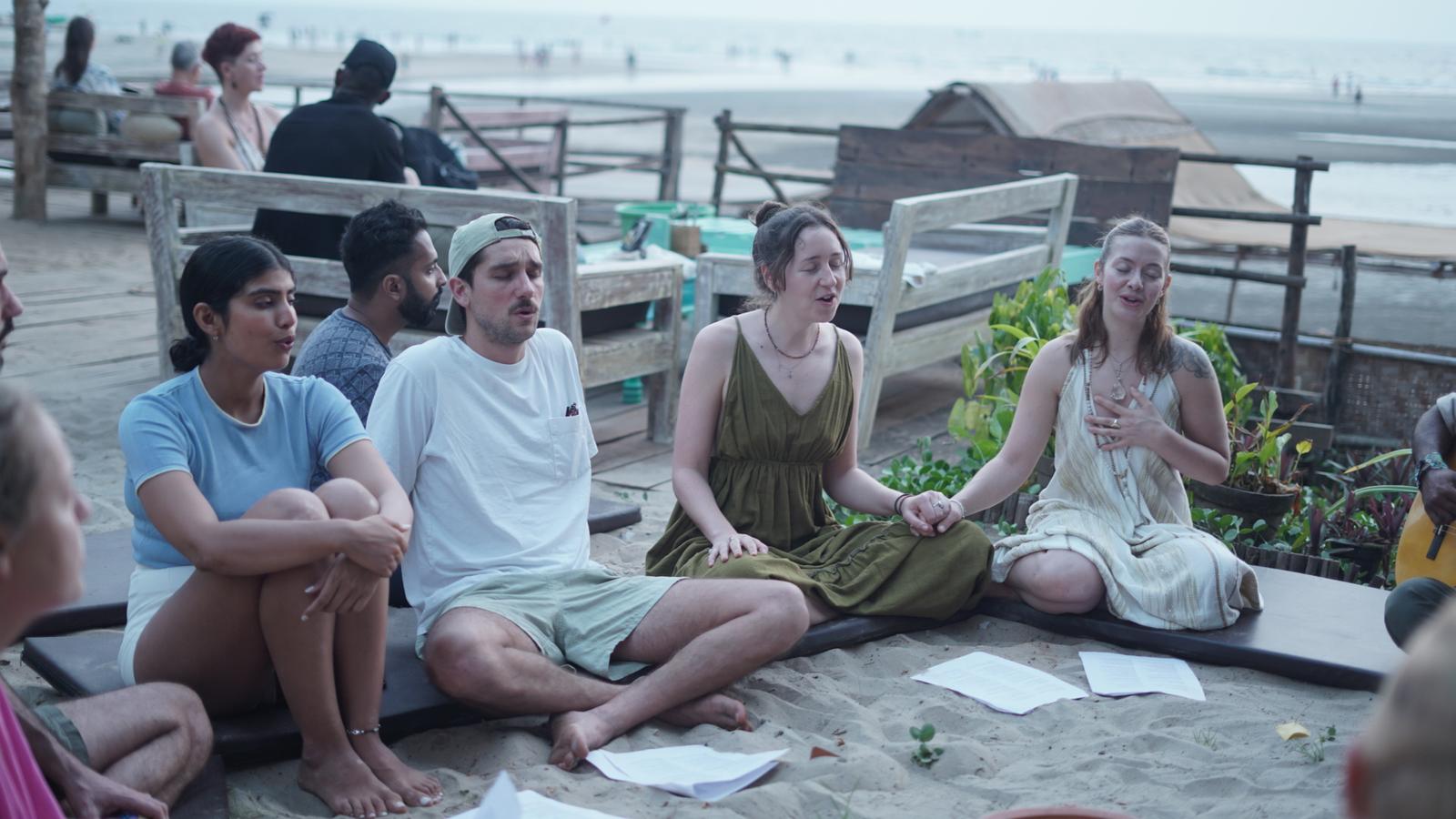
The assumption stops a lot of people before they even start looking.
I do yoga sometimes, they think. Or: I tried yoga once and couldn't do the poses. Or, most commonly: I'm not really a yoga person.
This is worth addressing directly, because the assumption is wrong in a way that matters. A yoga retreat - at least the kind that is worth attending - is not a convention for people who have been practising for years, have strong opinions about the Mysore tradition versus Iyengar, and travel with their own mat in a dedicated bag. That version exists, and it is perfectly valid. But it is not the only version. And it is not what most first-timers are actually looking for when they search for a retreat.
What most first-timers are looking for, underneath the search terms and the comparison shopping, is something simpler: a break. A reset. A few days where the environment is supportive and the pace is theirs to set.
Yoga, in this context, is not the destination. It is part of the structure that helps you get there.
What You Are Actually Signing Up For
At Nalanda, a yoga and wellness retreat involves a daily schedule that gives your time shape without filling every hour. Morning practice - typically pranayama (breath work) and asana (movement) - takes place in the early hours when the air is cool and the beach is quiet. Evening practice tends toward restoration: yoga nidra, restorative holds, meditation.
In between, the day is yours. You can sleep. You can read. You can walk the beach or sit in the garden. Meals at Chia Lounge are built around whole ingredients - warm, nourishing, surprisingly satisfying. Nothing is performatively healthy in the way that makes food feel like medicine.
If you have been to a fitness retreat and come back exhausted, this is a different thing. If you have been to a spa weekend and found it pleasant but somehow insubstantial, this is also a different thing. The structure of a retreat at Nalanda is designed to do something specific: give your nervous system the sustained, supported rest that it cannot manufacture for itself in your regular environment.

What Level of Yoga Do You Need?
Honestly? None.
The morning sessions at Nalanda are accessible to complete beginners. Teachers adjust for individual capacity; there is no expectation that you arrive able to touch your toes, hold a headstand, or understand Sanskrit terminology. What is expected - and this is the only actual requirement - is that you show up willing to breathe intentionally and move at whatever pace your body allows.
For guests who have some practice, there is depth available. The teaching at Nalanda is not superficial. Teachers here are practitioners first, and the sessions have a quality to them that experienced students often describe as unusually grounding. But depth is available, not required.
If you are genuinely uncertain whether you are physically capable of participating - whether due to injury, a health condition, or simply not having moved your body in a while - contact us before booking. Our team will tell you directly what is realistic rather than assuring you everything is fine to secure a reservation.
The Part Nobody Talks About: The First Day
For most first-timers, the first day of a retreat is the strangest.
You arrive, you unpack, you go to your first session. Somewhere in the early evening, after dinner, the silence that was a selling point starts to feel unfamiliar. Your phone is still accessible (we do not confiscate anything), but you notice yourself reaching for it less out of desire and more out of habit. You put it face-down and sit with the discomfort of having nothing to check.
This is the withdrawal period. It passes. For most guests, by day two, the silence has shifted from uncomfortable to restful. By day three, the structure of the day - practice, meal, rest, practice, meal, sleep - has a rhythm to it that feels less like a schedule and more like a reminder of how bodies actually want to live.
The signs that you need this kind of reset are usually pretty clear in retrospect: difficulty switching off, shallow sleep that does not restore, a feeling of being permanently slightly behind. A retreat does not fix these things permanently. What it does is demonstrate that they can shift - which is sometimes enough to change how you approach the months that follow.
Practical Questions Answered Directly
Do I need to bring my own mat? No. Equipment is provided.
Will I be with a large group? Nalanda hosts both open retreats and private groups. Open retreats typically have ten to twenty participants. If you want to know the specific number before booking, ask - we'll tell you.
What happens if I cannot do a particular pose or exercise? You modify or rest. Teachers are there to facilitate your practice, not to enforce a standard. No one will push you.
Is there Wi-Fi? Yes. We do not remove access. What changes is your desire to use it.
What should I pack? Light, comfortable clothing for movement and for the heat. One warm layer for the air-conditioned dining room. Walking sandals. Sunscreen. Nothing formal is needed.
A Word on the Location
Mandrem Beach is not the Goa that most people picture when they think of Goa. There are no beach clubs within earshot. The closest bar is far enough away that you will not hear it. The beach itself is long, quiet, and lined with the kind of low vegetation that makes it feel removed from everything, even when it is not.
For a first retreat, this specificity of location matters more than most guides acknowledge. A retreat held in a busy or visually distracting environment requires more effort from the participant to stay inward. Mandrem does some of that work for you. The environment is, in a practical sense, part of the programme.
You can read more about what makes Mandrem Beach distinct as a retreat destination - the quiet, the specific quality of the light, and why it has become the location of choice for practitioners who have tried retreats elsewhere and wanted something different.

Quick Answer: Do I need yoga experience for a retreat in Goa?
No. Nalanda's open retreats are designed to be accessible to complete beginners. The only requirement is willingness to participate at your own pace. Teachers adapt to individual capacity, and no prior practice is expected or assumed.
See all retreat programmes at https://nalandaretreat.com/programs/ or join a retreat at https://nalandaretreat.com/join-a-retreat/. For first-timer questions: reservations@nalandaretreat.com - we reply personally.
Frequently asked questions
What is a yoga retreat in Goa actually like for a first-timer?
Quieter and more structured than most people expect, in a good way. The daily schedule gives shape to your time without filling every hour. Most first-timers report that the first day feels unfamiliar and that day two onwards feels increasingly natural.
How long should a first yoga retreat be?
Five to seven days is the sweet spot for most first-timers. Three days is enough to decompress; five gives you time to actually settle. Anything under three days tends to feel like you arrived just as you were starting to relax.
What is the difference between a yoga retreat and a yoga class?
A yoga class is a scheduled session. A retreat is an immersive environment where the whole day - food, rest, practice, sleep - is designed to support a particular quality of experience. The sustained context is what makes the difference.
Is Goa a good destination for a first yoga retreat?
Yes, particularly North Goa. The combination of accessibility, calm environment, and established retreat infrastructure makes it one of the most practical destinations in Asia for a first retreat.
Will I lose weight on a yoga retreat?
That depends on the programme and your body. Our retreats are not weight-loss programmes. The food is nourishing and satisfying. Some guests lose weight; most do not notice significant change. What almost all guests notice is improved digestion and better sleep.
Can I attend a retreat alone?
Yes, and many guests do. Solo retreat attendance is common and, for many people, specifically the point- having their own space without social obligation. Mealtimes offer natural connection if you want it; nothing is forced.